The 3 Things Upper Primary Students Need to Know to Spell Big Words

By KELLIE
Upper primary students often struggle to spell long, multisyllabic words: the ‘big words’. Many rely on guessing or trying to rely on visual memory. Another ineffective strategy is to avoid even trying to use ‘big words’ when they are writing. There are some simple things teachers can do to teach them the skills to make big words more predictable and manageable.
There are universal or common errors teachers see in Year 5 and 6 students attempts at spelling: omitted internal phonemes, confused vowel sounds (especially in unstressed syllables), incorrect grapheme selections, or the production of the parts of the words they know and recognise. These errors may be occurring because many students are relying on visual memory rather than the linguistic skills required for accurate spelling.
To be successful spellers of multisyllabic words, students must coordinate phonology (sounds), orthography (grapheme patterns), and morphology (meaning) (Moats, 2010; Kilpatrick, 2015; Ehri, 2014; Carlisle, 2010).
Understandably, when these underlying skills are weak, big words seem unpredictable and overwhelming. But, when these skills are taught explicitly, misconceptions addressed quickly, and consistent word study or word investigation routines are established, multisyllabic word spelling becomes logical and manageable (and even worth the risk!).
Why spelling multisyllabic words matters.
Being able to spell more complex words is important because without this ability, students are limited to what they can ‘say’ when writing. This is another common thing teachers see in upper primary classrooms, avoidance. If students are not confident enough to try to spell longer, more difficult words, many will choose simpler vocabulary or avoid writing altogether.
This is not about carelessness, or lack of effort. The act of spelling a word draws on working memory. Labouring over how the letters might work together increases cognitive load. For some students the cognitive demands of spelling the more difficult word over one they already know are too much.
It is interesting that even fluent reading may not prevent this. Research has revealed that reading and spelling share underlying mechanisms. The key difference is that generating an accurate spelling requires more precise access to phoneme–grapheme and morpheme information than recognising a familiar printed word. This is why many strong readers remain inconsistent spellers through the upper primary years.
So, in simple terms, big words are hard because key skills are missing. It is not because English spelling is inherently unpredictable. That’s good news for teachers too. You just need to know what 3 skills to teach.
“Reading and spelling share underlying mechanisms. The key difference is that generating an accurate spelling requires more precise access to phoneme–grapheme and morpheme information than recognising a familiar printed word.”
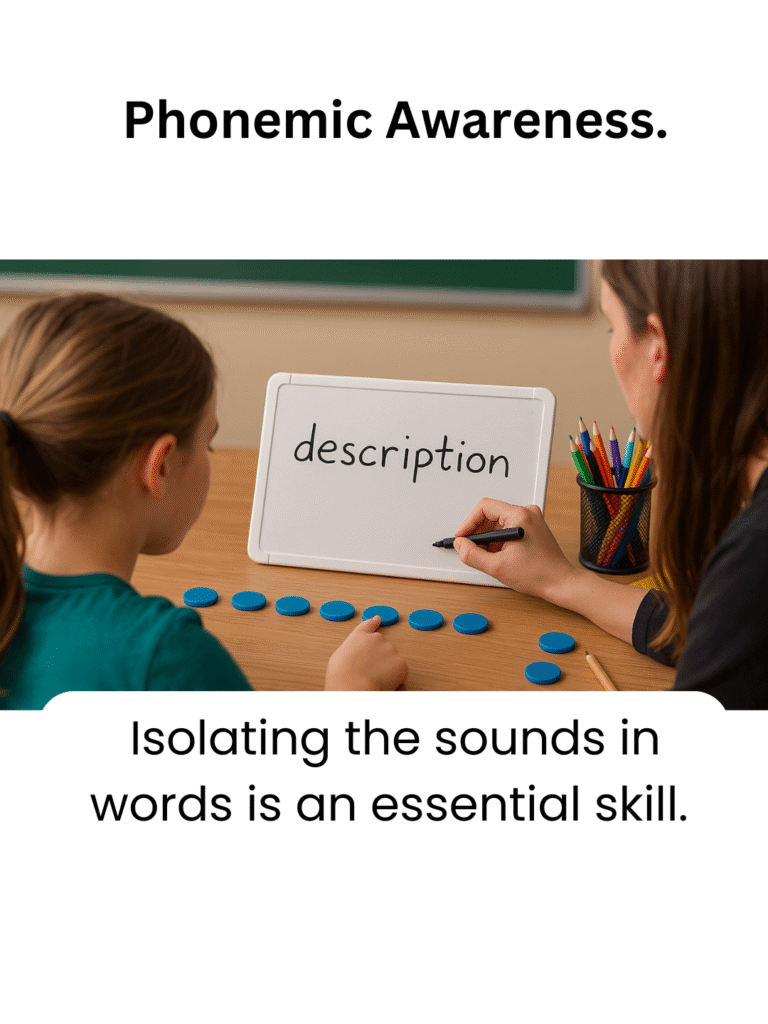
Skill one: Phonemic awareness
Phonology is the entire sound system of a language. Phonemic awareness is a subset and refers to one significant part of that sound system: the ability to consciously notice, think about, and manipulate individual phonemes in spoken words. Phonemic awareness remains a critical foundation skill even in upper primary. Spelling requires students to perceive and sequence every phoneme (speech sound) before selecting graphemes (letters). This is usually harder in longer words, where reduced vowels, unstressed syllables, assimilations and consonant clusters can obscure the sound structure.
Without the ability to hear and isolate each phoneme (speech sound), spelling becomes guesswork rather than a code-based process. Many multisyllabic spelling errors occur because students overlook or mis-hear reduced or unstressed vowels, omit internal consonants, or fail to maintain the full sound string before writing.
In practice, commonly misspelt words that appear as difrent, libry, and intresting. These occur mainly because students don’t detect one or more internal phonemes, or are mispronouncing the words. They write what they think they hear, not the full phonological sequence.
This is consistent with research showing that accurate spelling depends on fully specified phoneme sequences, especially when words contain schwa or complex clusters. Students benefit from being taught and supported to slow down the spoken form of long words and isolate the sounds. Deliberately rehearsing the phonemes improves accuracy because it gives them the complete sound structure before they attempt to map letters. Before they try to write the letters.
Because of this, phonemic awareness instruction continues to benefit older students. Research suggests that the benefits of this go well beyond their schooling years.
Contemporary views on spelling instruction define fine-grained phonemic awareness as necessary for linking sounds to letters during orthographic mapping, which is the basis of accurate spelling.
Skill two: morphological awareness
Morphological awareness is knowing that words can be broken into smaller units of meaning. Knowing this helps students break big words into meaningful parts. English spelling is morphophonemic, meaning many spellings are anchored in meaning rather than sound alone. Research consistently shows that morphological knowledge supports spelling, vocabulary, and reading comprehension, especially in upper primary when encountered words become increasingly more complex.
Students who lack morphological awareness tend to spell long words as one continuous string of letters. It may also be obvious that as they spell these words they are relying on restrictive ‘sounding out’. Some examples of misspellings I have recently encountered include distrukshun (destruction) and rasponsabul (responsible). The misspellings are most likely occurring because the student has no internal framework for the units of meaning in these words: con + struct + ion or re + sponse + ible. When students learn to identify prefixes, base words, and suffixes, spelling becomes more about assembling predictable chunks than memorising long strings. Understanding morphology reduces cognitive load and gives students stable spelling anchors that can be applied to many different words.
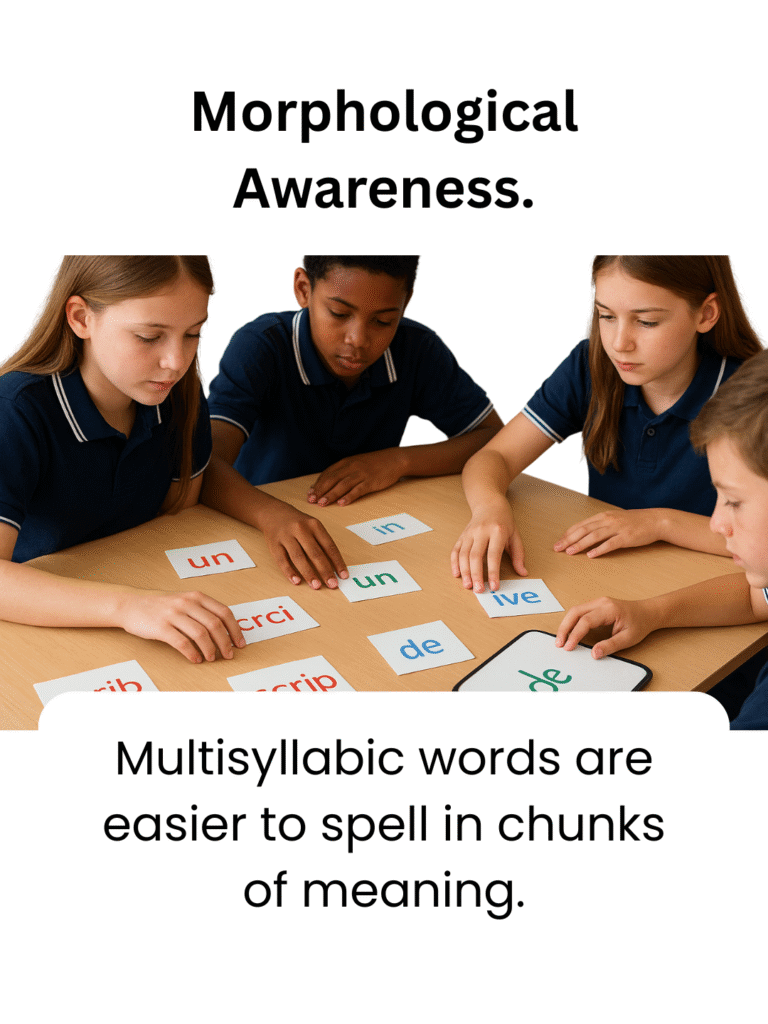
Morphological awareness is crucial in upper primary. When students understand how prefixes, base words, and suffixes work, big words become manageable. When students recognise the meaning connections between words, they have something to rely on for spelling instead of memorisation. If you only going to make one change to how you teach spelling, make it about teaching morphology. It’s a big call, I know, but I stand by it.
Skill three: orthographical knowledge
Orthographic knowledge is understanding the predictable spelling patterns, generalisations, and constraints of English. This includes grapheme–phoneme correspondences, typical letter sequences, suffix behaviour, long vowel patterns, and how morphemes retain consistent spellings across related words. English spelling usually appears irregular to students when they have not been explicitly taught these patterns.
Common orthographic patterns relevant to multisyllabic word spelling include the behaviour of suffix families. The suffixes –ion, –able, –ible, –ive, –ure generally feature in the upper primary curriculum. When we are learning to apply these suffixes to base words it helps to know that there are some reliable conventions, or generalisations about how base words behave when these affixes are added. For example, almost every word that ends in a silent letter [e], requires us to drop the [e] when adding a suffix that starts with a vowel sound (a,e,i,o,u or y). Celebration. Creative. Valuable. For the most part this is pretty reliable generalisation to know. For the most part. There are exceptions, but these are usually far less common than the generalisation.
When these patterns are identified, and taught systematically, many spellings that seem irregular become understandable. Orthographic knowledge allows students to make informed spelling choices and self-correct when something does not look right based on pattern familiarity.

Orthographic knowledge is essential because English spelling follows patterns that students must learn in order to spell long words accurately. These patterns include common grapheme–phoneme correspondences, typical vowel spellings in unstressed syllables, and the predictable behaviour of suffixes. When students know these conventions, they can choose plausible spellings and check their work against what they know about how English words are usually written.
These three skills work together.
Spelling big words requires all three skills to operate at once.
- Phonemic awareness provides the complete sound sequence.
- Morphological awareness provides the meaning structure.
- Orthographic knowledge provides the conventional spelling patterns.
Modern models of word learning explain that accurate spelling is built by linking phonology, orthography, and meaning. If any strand is weak, spelling ‘success’ becomes inconsistent. If all three are strong, students can analyse and encode long words reliably.
This integrated view aligns with the science of reading and writing: orthographic mapping relies on the connection of sounds, letters, and meaning. Morphophonemic structure explains why English spelling is far more predictable than students (and some teachers) initially believe. Working memory limitations explain why students struggle when they cannot chunk words meaningfully. All three perspectives converge on the need for explicit, structured instruction.
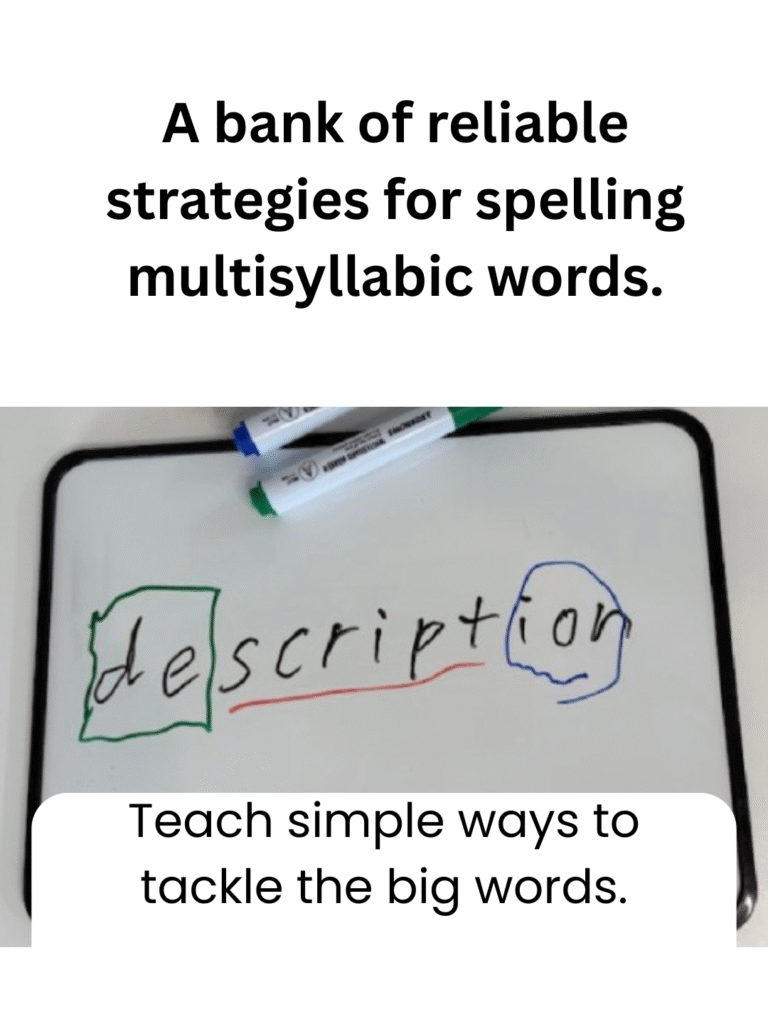
What upper primary teachers can do next.
Instruction that improves multisyllabic spelling in upper primary focuses on:
- isolating the phonemes in multisyllabic words
- routine morphological analysis of more complex words including common prefix and suffix families
- explicit teaching of spelling patterns and generalisations
- opportunities to encode (not just decode) big words in context.
Research-informed guidance emphasises that older students benefit from regular, almost daily explicit instruction in these skills because multisyllabic spelling will not develop through exposure alone. A structured approach gives them a repeatable process they can transfer to new words.
It might feel overwhelming when faced with the idea of how to teach all three strands of spelling without a structure. Especially when for most of us, we were taught to teach spelling through word lists and memorisation. That is why we created the Spelling and Word Study Program. It has been designed to integrate phonology, morphology, and orthography into one clear teaching sequence. Every lesson builds the skills the science of reading identifies as essential for accurate spelling. If you want your students to spell big words reliably, this gives you the path to get them there.
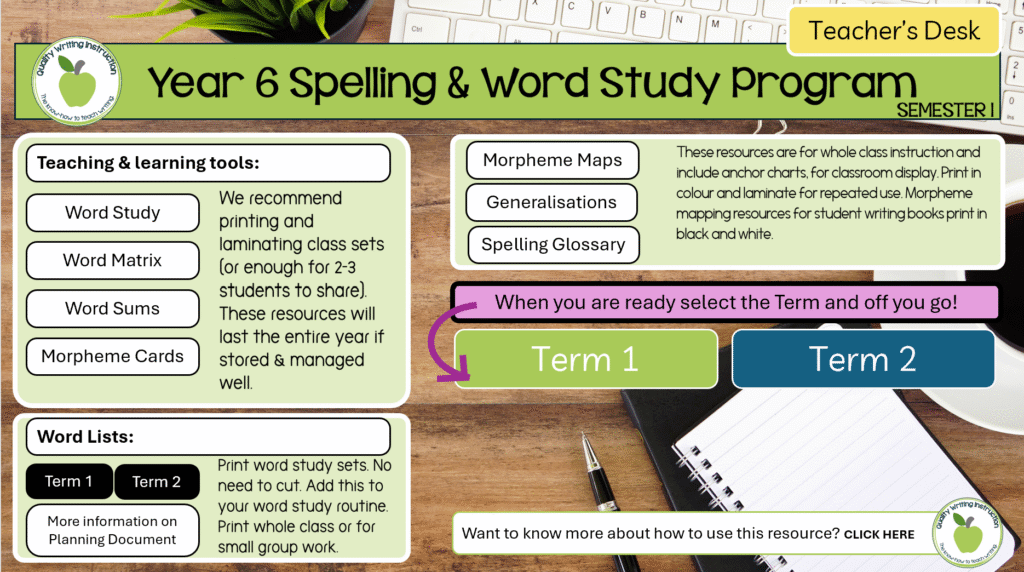
The Year 6 Spelling and Word Study Program is a full semester of carefully planned, sequential and aligned spelling instruction.

Let’s learn from each other! Join us in The Lounge to share how one small shift you’ve made in your spelling instruction has made a big difference. We’d love to hear if you found this article useful! Join us in The Lounge.
“The Lounge” is Quality Writing Instruction’s Facebook group, where you can share ideas and get support from a fabulous group of like-minded teachers. It is currently under renovation but we’d love you to drop by!