How We Teach Spelling in Australia: What's Changing and Why It Matters.

By KELLIE
We are currently rethinking spelling instruction with the Science of Reading. There is a lot of discussion (hot talk) about how we teach spelling in Australia and what is changing. We are hearing language like morphology, orthography and structured word study flying around. You’re not alone if you’ve sat through a professional learning session lately and quietly thought ‘but how do we ACTUALLY do that?’ …
In this post I will cut through some of the talk and share what I think it really means for classrooms.

Over the past few weeks, I have spent quite a bit of time reading, thinking and reflecting on recent discussions around morphology, orthography and structured word study. (Don’t judge me!) That research included some recently released departmental advice documents on teaching spelling and word study.
When I first sat down to read, I expected to skim through fairly quickly and move on. Instead, I found myself stopping. A lot. Rereading. Thinking. Taking notes. Occasionally having a full ‘this is actually a bigger shift than I realised’ moment.
And the more I sat with it, the more I became convinced that what we are seeing is not just another tweak to how we teach spelling. It is a meaningful shift in how we understand spelling. And that distinction matters.
I want to share a few of the things that stood out to me most. Not as a policy expert (I want to be clear about that) but as someone who has spent a long time thinking about literacy, curriculum and what actually works in classrooms.
These are my takeaways, and I hope they help make some of this feel a little less overwhelming and a little more exciting.
1. The way we think about teaching spelling is changing - and that's the whole point.
One of the clearest messages running throughout the research is that spelling is far more than memorising how words look. (I know this sounds a bit “No shoot, Sherlock” when you say it out loud.) But in practice, that assumption has influenced so much of what we have traditionally done when teaching spelling.
We gave students lists, used the words every now and again, tested them… then moved on.
The new direction is pointing us towards something richer. In practical classroom terms, students are not just learning sounds, spelling patterns and rules. They are also learning about meaningful word parts, how the connections between words, and why words we spell words the way we do. This is deep language knowledge, not just memorisation.
This reframe is genuinely something helpful for understanding something that has bothered and frustrated teachers for years. It helps explain why some students can pass weekly spelling tests but still struggle to spell those words independently in writing. The words just didn’t transfer because they didn’t really understand them.
My hot take: This move toward deep word knowledge and understanding how words work is long overdue. We’ve seen the pieces of the puzzle strewn across tables. Now we’re finally seeing the whole picture.
2. A statistic stopped me in my tracks.
This is one specific idea that made me really stop and think.
“Over 95% of English words are regular when morphology, phonology and etymology are considered.”
Many of us grew up being told (or it least it was strongly implied) that English spelling is inconsistent and full of exceptions. You either pick it up or you don’t. But this insight suggests something more nuanced than that.
When taught in isolation, English spelling IS more likely to be unpredictable.
But, when students understand the sounds (phonology), the spelling patterns (orthography), and the meaning (morphology), most English words will make sense. Understanding the history of these words adds even more depth.
My hot take: This single idea that we teach spelling through 3 word knowledges has significant implications for how we approach spelling instruction. It also challenges some strongly held common beliefs!
When we teach spelling through sounds, patterns, and meaning most of English spelling actually makes sense
3. Morphology is broader than we tend to think.
I know the word morphology can sound intimidating. It even sounds mystical! A lot of us associate it with multisyllabic words, Greek roots and Latin bases. We assume it belongs in upper primary vocabulary work. And, if we are honest, more suited to some students over others.
But one of the most reassuring things I took from this research is the morphology is far broader than that. In plain terms, morphology is about meaningful word parts. This includes things we are already teaching every day.
This is not new to Australian classrooms. Students are already learning how meaningful parts (morphemes) work together. Morphemes build words and affect meaning. Teaching this starts in the very early years.
- dog + s = dogs
- jump + ing = jumping
- un + happy = unhappy
- gold + fish = goldfish
What is genuinely exciting about this is what it does to the way students see words. Instead of each word as a separate thing to memorise, morphology helps students understand that words are connected.
Once they know how words are ‘built’, they can work out multisyllabic words and words they’ve never seen or heard before.
One base. Many words.
One base word gives students pathways to many other words. This is what deep word knowledge looks like in practice.
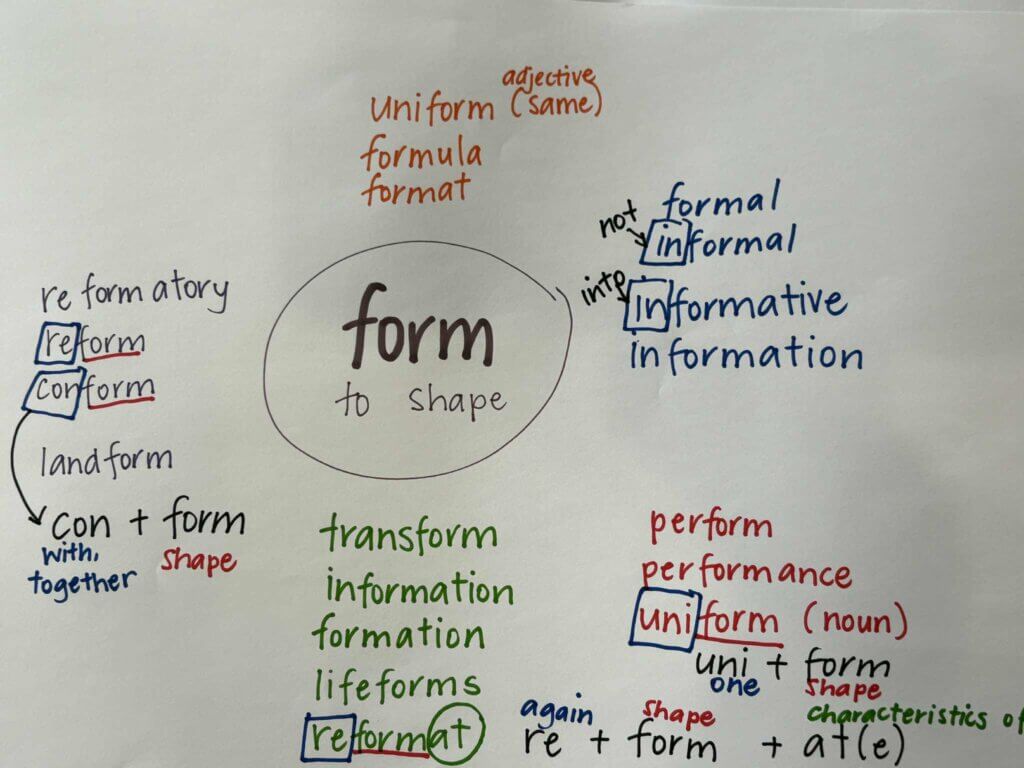
When students learn that there are connections between words, their spelling, vocabulary, reading comprehension, and writing are all strengthened.
My hot take: Other than pure joy? This broad understanding of morphology is one of the most significant shifts in evolving spelling instruction. We just need to reframe how we feel about the shift and think of it as extending what we are already doing.
4. How we teach spelling is no longer seen as sitting in English.
Another message that caught my attention was the strong emphasis on curriculum vocabulary. This is a central idea that word study should connect across learning areas, not sit in isolation inside English lessons.
Think about words like reaction, construct, transform, civilisation, inactivity. These words are often treated differently when we encounter them in science, Health or HASS. To fully access the curriculum, students need to understand these words. They need to say them, read them, spell them, understand them, break them apart and use them confidently.
The message is that spelling is an integral part of literacy. Teaching spelling currently sits in English, but it belongs across the curriculum. Teaching curriculum words has always been through definitions, but it should include spelling. And spelling is taught through the 3 word knowledges.
My hot take: There are many teachers who have always worked toward more connected, integrated teaching of spelling across the curriculum. I also know that ‘sometimes’ this pull has been pushed against by time and other constraints. So, this is should also feel like a validation.
When we move how we think about teaching spelling from English to ‘literacy’, we start teaching them how words work across every subject. That is the magic of how English works… and once students see it, they cannot unsee it.
5. There are BIG challenges for schools.
The direction in spelling instruction is genuinely excellent. The research is compelling, the shift makes sense, and teachers who engage with it see that is actually works. It will make a difference to how students understand and work with words.
In one recently released advice document, it was openly stated that there will be no formal morphology scope and sequence. So, we’re been told where to go, but not how to get there.
For curriculum leaders and literacy teams, this is going to raise some really hard questions. What do we teach and when? How will this sit beside what we are already doing? What does a whole-school approach really look like? How do we build spelling and word study so that it is cumulative and not just a collection of interesting word activities?
My final hot take (and quite possibly the last time I ever use that phrase). These important questions mustn’t be an excuse not to get started. These are exactly the conversations we need to be having now. Teachers are remarkably good at making sense of complexity when they have practical, structured support alongside the theory.
It’s clear that the focus is on teaching how words work because understanding how words work strengthens reading, writing, spelling and vocabulary.
In my next post, I will look at what this will look like in practice.
Because “How do we actually do this?” is a genuinely relevant question, and it deserves a real answer.
In the meantime, read one of my earlier blogs for more about the 3 Word Knowledges.
If you’re keen to make changes but don’t know where to start… read 5 Small Changes for Big Impact.
Let’s learn from each other! Join us in The Lounge to share how one small shift you’ve made in your spelling instruction has made a big difference. We’d love to hear if you found this article useful! Join us in The Lounge.
“The Lounge” is Quality Writing Instruction’s Facebook group, where you can share ideas and get support from a fabulous group of like-minded teachers. It is currently under renovation but we’d love you to drop by!